Freezing of Ahmed Sinai's Assets
Midnight's ChildrenThe Freezing of Ahmed Sinai's Assets is the government’s abrupt seizure of Ahmed Sinai’s access to his wealth, conveyed through a formal letter and experienced as both public humiliation and private bodily catastrophe. The order blocks his bank account, savings bonds, and rents from the Kurla properties; its consequences reach beyond money, chilling his marriage and becoming the occasion for the conception of Brass Monkey.
The letter and its arrival
The episode begins with a contrast between correspondence as a shaping force in family life and this letter’s particular violence. The narrator recalls that the Prime Minister had written to him when he was seven days old, and that readers of The Times of India had sent fan letters before he could wipe his own nose. In January, Ahmed too receives a letter he will never forget. The sequence makes an ordinary instrument of communication the means by which state power enters the household.
The letter’s arrival is staged through the routines of a working morning: Ahmed’s red eyes at breakfast, his shaven chin, footsteps on the stairs, and the Coca-Cola girl’s alarmed giggles. At his desk, a metal paper-cutter rasps through the envelope. A minute later, Ahmed runs upstairs calling for his wife. The small delay between opening the paper and announcing its contents gives the order a sudden, theatrical force: private reading becomes an immediate domestic emergency.
What the order takes
The state has frozen all of Ahmed’s assets. He enumerates the losses with mounting insistence: his bank account, savings bonds, and rents from the Kurla properties are all blocked. He says the letter gives the order but offers no usable explanation or relief. His repeated measures of small change—four annas, not even a chavanni, not ten pice for a twist of channa, not one anna for alms—make the abstract seizure tangible as an inability to spend, give, or even visit a peepshow.
The narrator’s account places the freeze in a political atmosphere in which the family’s financial exposure is already being discussed. Doctor Narlikar arrives perspiring and blames himself for the partners having become too public. He warns that freezing a Muslim’s assets may drive him to Pakistan, leaving his wealth behind, and condemns the supposedly secular state’s ingenuity. His explanation is a character’s interpretation of the event, not an independently established account of the government’s motive; the letter itself is reported as an order, while the reason for selecting Ahmed remains uncertain in the scene.
Ahmed’s response condenses financial dispossession into a recurring image. He calls himself broke and frozen, then compares the condition to water and finally to a refrigerator. The metaphors give the order a physical temperature: his wealth is not merely inaccessible on paper but imagined as ice lodged in his body. The narration turns an administrative decision into an injury that seems to spread from the public world into intimate life.
Coldness within the household
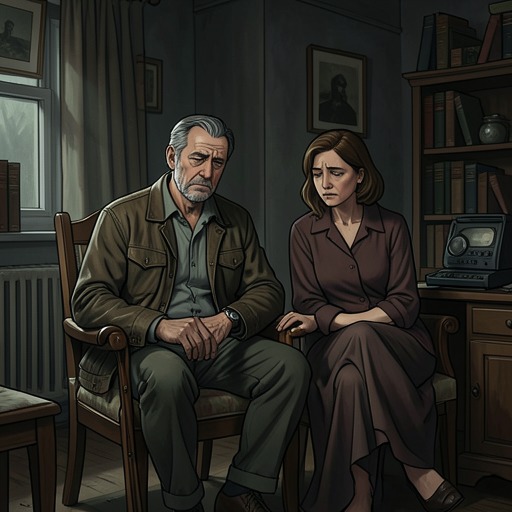
Ahmed’s wife tries to interrupt his despair by leading him to the bedroom to lie down. Their attempted intimacy makes the freeze literal in comic, unsettling fashion: when she reaches down, she discovers that the cold he has been describing is physically real. The episode’s grotesque humor does not cancel the damage; it makes the state’s power register in the most private part of the marriage.
The narrator later connects this change directly to the seizure. On the first day after the assets are frozen, Brass Monkey is conceived. Afterward, Ahmed’s wife lies with him night after night in an effort to warm him, and snuggles close when he shivers. Yet the cold intensifies until she can no longer bear to touch him. The conception is thus set beside the onset of a prolonged estrangement in physical intimacy: a new child begins in the very period when the marriage’s ordinary means of warmth are becoming impossible.
Narrative and significance
The event’s telling moves between documentary particulars—the formal letter, the named assets, the dates’ imprecise January setting—and a deliberately extravagant bodily image. The narrator makes the freeze legible through repetition: money is blocked, Ahmed is broke, and his body is cold. This conversion of financial fact into physical sensation binds political power to household life without reducing the episode to a simple explanation of motive.
The letter also stands among the communications that shape the family’s history, but unlike a congratulatory message it announces a loss that Ahmed cannot appeal away in the moment. Its effects persist after the envelope is opened: it alters his sense of security, provokes anxious political talk, and changes the terms of intimacy between husband and wife. The episode’s closing detail of Brass Monkey’s conception holds birth and deprivation together, making the asset freeze both an economic event and a turning point in the family’s private life.